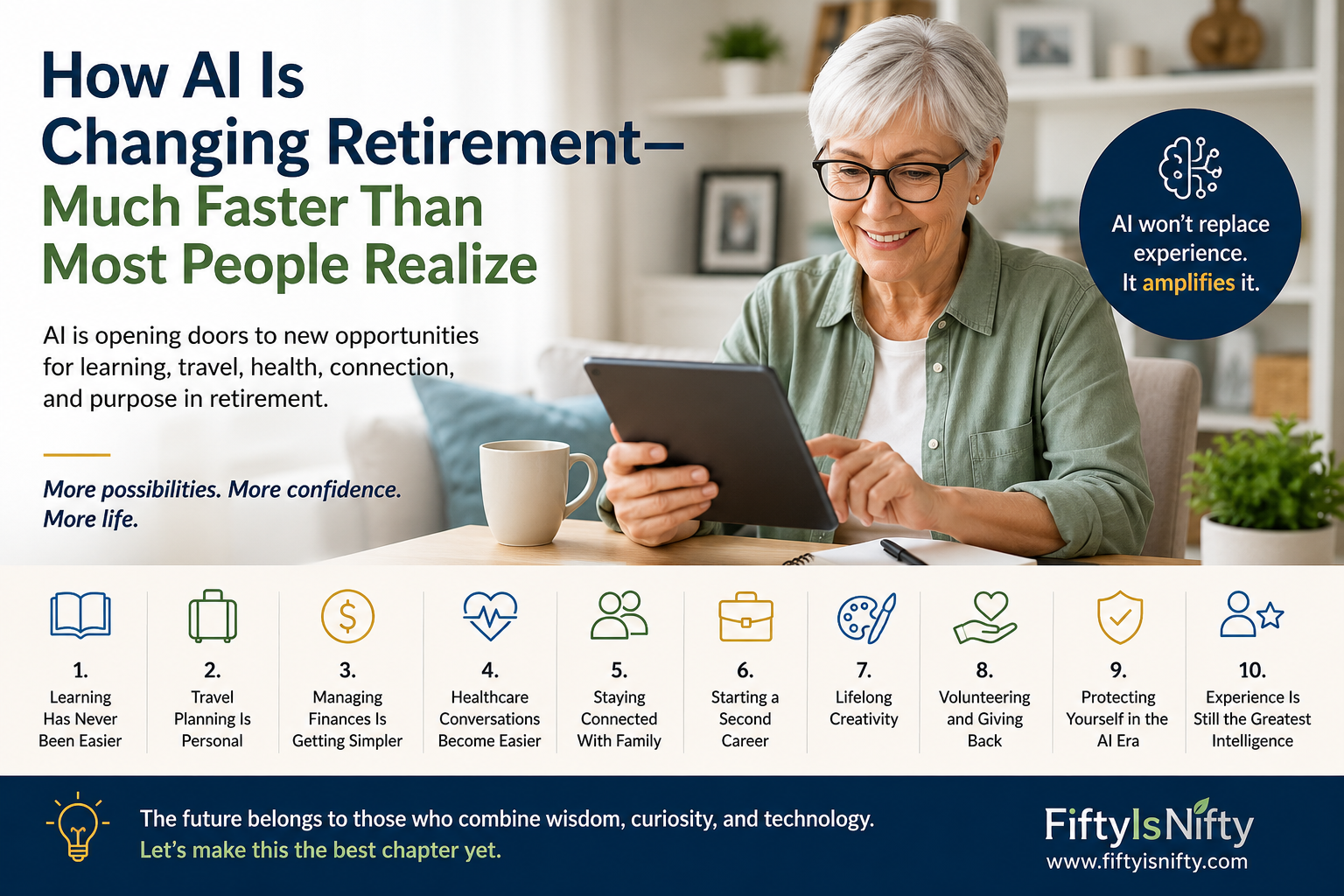
How AI Is Changing Retirement—Much Faster Than Most People Realize
For decades, retirement followed a familiar path.
You worked hard, retired around age 65, traveled a little, spent more time with family, and gradually slowed down.
Artificial Intelligence (AI) is beginning to rewrite that story.
Today’s retirees—and those planning for retirement—have access to technology that can act as a personal assistant, tutor, travel planner, financial organizer, creative partner, and lifelong learning companion. While AI won’t replace human relationships or life experience, it is becoming an incredibly useful tool for making retirement more active, informed, and enjoyable.
At FiftyIsNifty, we believe retirement should be viewed as the beginning of a new chapter—not the end of one. AI can help make that chapter richer than ever before.
1. Retirement Learning Has Never Been Easier
Many people retire with a long list of things they’ve always wanted to learn:
- Photography
- Painting
- Music
- Cooking
- History
- Astronomy
- Genealogy
- A new language
In the past, learning often required enrolling in classes or purchasing expensive courses. Today, AI can serve as a patient, personalized tutor that answers questions, creates lesson plans, and explains difficult concepts at your own pace.
The result is that learning no longer has an age limit.
2. Travel Planning Is Becoming Personal
Planning a trip can take hours of research.
AI can now help you:
- Build personalized itineraries
- Compare destinations
- Suggest restaurants
- Estimate budgets
- Recommend attractions based on your interests
- Create day-by-day schedules
Instead of spending days researching online, you can spend more time enjoying the journey.
3. Managing Finances Is Getting Simpler
Retirement often brings new financial questions:
- How long will savings last?
- How should monthly expenses be managed?
- Which subscriptions are no longer needed?
- What budget works best?
AI isn’t a replacement for professional financial advice, but it can help organize information, explain financial concepts in plain language, identify recurring expenses, and prepare thoughtful questions for meetings with financial advisors.
Knowledge leads to better decisions.
4. Healthcare Conversations Become Easier
Medical information can feel overwhelming.
AI can help people:
- Understand medical terminology
- Prepare questions before appointments
- Organize medication schedules
- Summarize health information in plain English
- Research conditions using reputable sources
It’s important to remember that AI should never replace licensed healthcare professionals. Instead, it can help people become more informed participants in their own care.
5. Staying Connected With Family
Many grandparents want to stay connected with children and grandchildren but sometimes struggle with rapidly changing technology.
AI can help with:
- Writing emails
- Creating birthday messages
- Organizing family photos
- Creating memory books
- Learning new apps
- Explaining social media trends
Technology becomes less intimidating when someone—or something—is available to answer questions without judgment.
6. Starting a Second Career
Retirement doesn’t always mean stopping work.
Many retirees choose to:
- Consult
- Mentor
- Teach
- Volunteer
- Start small businesses
- Write books
AI can assist by:
- Creating presentations
- Brainstorming business ideas
- Designing websites
- Writing marketing content
- Drafting proposals
- Organizing research
Rather than replacing experience, AI amplifies it.
7. Lifelong Creativity
Many people discover their creative side after retirement.
AI can help with:
- Writing stories
- Creating artwork
- Designing greeting cards
- Producing family newsletters
- Planning community events
- Recording podcasts
- Creating videos
The barrier between “I wish I could…” and “I can” has never been lower.
8. Volunteering and Giving Back
Retirement offers the opportunity to make a lasting difference.
Community organizations increasingly rely on volunteers with experience in leadership, education, healthcare, finance, technology, and business.
AI can reduce the administrative work by helping volunteers:
- Draft emails
- Create presentations
- Organize events
- Build newsletters
- Manage schedules
- Develop educational materials
Less paperwork means more time making an impact.
9. Protecting Yourself in the AI Era
While AI offers tremendous opportunities, retirees should also be aware of new risks.
Always remember:
- Never share passwords with AI tools.
- Be cautious of AI-generated scams and fake phone calls.
- Verify financial or medical information through trusted sources.
- Think critically before acting on AI-generated advice.
Just as important as learning AI is learning how to use it wisely.
10. Experience Is Still the Greatest Intelligence
AI can answer questions in seconds.
But it cannot replace decades of life experience.
It has never raised children.
It has never comforted a friend.
It has never built a career.
It has never learned through failure.
Those experiences remain uniquely human.
The future belongs not to AI alone, but to people who combine wisdom, curiosity, and technology.
Looking Ahead
Artificial Intelligence is changing retirement much faster than many people expected.
Instead of seeing retirement as a time to slow down, many people are discovering new opportunities to learn, create, travel, mentor, volunteer, and stay connected.
At FiftyIsNifty, our mission is to help adults embrace these opportunities with confidence. Through educational programs, community events, and practical AI learning, we believe everyone can benefit from understanding this rapidly evolving technology.
Retirement is no longer simply about having more free time.
It is about having more possibilities.
The future is not just for younger generations.
With the right mindset—and the right tools—it belongs to everyone.