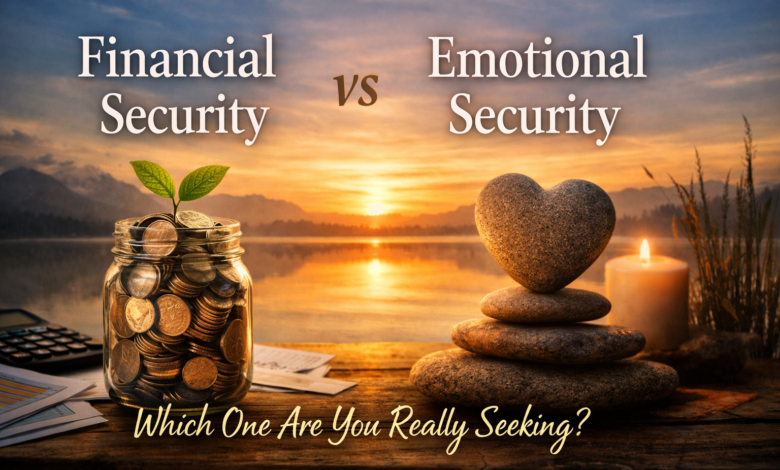
Financial Security vs Emotional Security — Which One Are You Really Seeking? (2026 Reflection)

Lately, the financial headlines feel confusing.
One day, mortgage rates are falling and creating optimism.
Another day, reports show more people struggling with payments.
Markets move up — then uncertainty returns.
And quietly, many midlife adults feel something deeper than financial concern.
They feel emotional unease.
Recent reports show rising mortgage delinquencies as households struggle with persistent living costs, even as inflation cools — a reminder that financial stress is not always about income alone but about psychological pressure and unpredictability.
At the same time, mortgage rates dipping below 6% for the first time in years offer hope — yet housing affordability, job uncertainty, and insurance costs still leave many people feeling hesitant rather than relieved.
This contradiction is exactly where the emotional question begins.
If financial indicators improve, why don’t we always feel safer?
The New Reality: Stability Feels Temporary
Markets today are shaped not just by economics but by technological disruption, AI job uncertainty, and shifting employment patterns — factors that are quietly influencing investor behavior and personal confidence.
In fact, research shows that nearly half of retirees fear running out of money despite years of saving — highlighting that emotional insecurity can persist even when financial preparation exists.
This reveals a powerful truth:
Financial stability does not automatically create emotional calm.
Because midlife is when people begin to realize that certainty itself has become fragile.
Why Midlife Makes This Question Louder
By the time we reach our 50s and 60s, we have already experienced:
- market swings
- unexpected expenses
- career uncertainty
- caregiving responsibilities
- health surprises
- shifting retirement expectations
Even retirement planning itself is becoming more complex due to inflation, interest-rate shifts, and market volatility affecting purchasing power.
So the emotional need evolves.
We stop asking, “Am I doing enough financially?”
And begin asking, “Will I feel safe no matter what happens?”
The Quiet Fear Behind Financial Planning
Much of our financial effort is actually emotional protection in disguise.
We save for:
- independence
- dignity
- the ability to help loved ones
- freedom from anxiety
- protection from becoming a burden
In other words, we are not saving for money.
We are saving for peace.
And peace cannot be stored in an account.
The Opportunity Hidden Inside Today’s Uncertainty
Interestingly, the same economic uncertainty that creates anxiety can also create emotional growth.
Lower interest rates may ease borrowing costs — but they can also reduce savings yields, reminding people that financial strategies must constantly adapt.
This environment encourages something powerful:
psychological flexibility
Midlife individuals often discover that resilience, adaptability, and perspective become stronger sources of security than any single financial milestone.
What Emotional Security Really Feels Like
Emotional security does not mean the absence of uncertainty.
It feels like:
- trusting your ability to adjust
- knowing you have survived past instability
- valuing relationships as much as resources
- recognizing that identity is bigger than income
- feeling calm even without perfect clarity
This is the wealth that experience quietly builds.
A Gentle Reframe
Financial planning is essential.
But emotional security is foundational.
Money can protect your future.
But resilience protects your peace.
And the truth many midlife adults eventually discover is this:
You are not secure because the economy is predictable.
You are secure because you have become adaptable.
That realization creates a calm that headlines cannot disturb.
🌿 A Conversation Worth Having
When you think about security, what brings you more peace — a financial number, supportive relationships, trust in your adaptability, or something else entirely?
Sometimes the answer reveals what we have truly been seeking all along.